Topics in Middle East History
Chapter 12: Crusaders and Mongols
Copyright ©2010, 2011 by T. Pavlidis
A Tumultuous Period
The defeat of the Byzantines at Manzikert in 1071 ushered a period of upheavals in the region we call Middle East. For a while the Seljuk empire was dominant but that dominance was challenged by the Crusaders who over a period of nearly 200 years fought not only the Muslim powers but also the Byzantines. The first Mongol invasion in the early 1200's produced more upheavals and it was not until the mid 1300's that a power had risen that was eventually going to dominate the region. These were the Ottoman Turks. A second Mongol invasion in 1402 delayed their rise, but in 1453 the Ottomans took Constantinople and dominated the region until the 20th century. In many ways, they were the successor state of the eastern Roman Empire. Their rise will be the subject of Chapter 13, after we deal with the main events of the 1071-1400 period.
| The Crusades at a Glance | |||
|---|---|---|---|
| The Crusaders: Western Europeans (French,
German, English). Their Opponents: Mameluk armies under Seljuk or Ayyubid Turk rulers. The Role of the Byzantines: Originally allies of the Crusaders, very soon opponents. |
|||
| Goal: Ostensibly to liberate the Holy Land from Muslim rule. In reality looting of the riches of the region (hence their attacks on the Byzantines). | |||
| Crusade | Years | Leader(s) | Comments |
| People's | 1096 | Peter the Hermit | Slaughtered by the Seljuk Turks in Asia Minor. |
| First | 1097-1099 | "Liberation" of Jerusalem. Establishment of four crusader states around Jerusalem, Edessa, Antioch, and Tripoli. | |
| Second | 1147-1149 | Kings Louis VII and Conrad III | Atrocities against the Jews in Rhineland. No gains in the Holy Land. However success in the West, taking Lisbon from the Muslims. |
1187 |
Saladin recovers Jerusalem |
||
| Third | 1191 | Richard the Lionhearted and Frederick I | Capture of Cyprus from the Byzantines. Recapture of Acre and Jaffa from the Turks. |
| Fourth | 1204 | Capture of Constantinople. Establishment of Crusader states in Byzantine Lands. | |
| Fifth | 1217-1221 | Some initial success in Egypt, but eventual defeat. | |
| Sixth | 1228-1229 | Emperor Frederick II | Brief recapture of Jerusalem. |
| Seventh | 1248-1254 | Louis IX of France | Attacks at Egypt, but no gains. Templar Knights appear on the scene. |
| Eighth | 1270 | Louis IX of France | Diverted to Tunis where Louis died. |
| Ninth | 1272 | Did not achieve anything. Last crusader state in Acre fell in 1291. | |
The Crusades
The Turkish conquest of the Holy Land caused an outcry in Europe and led to the Crusades. A major motive for the Crusaders was to get hold of the wealth of the region and the first crusade in 1097 resulted in four Crusader states and some territorial gains for the Byzantine empire that we discussed in Chapter 11. Several crusades followed. The second crusade took place in 1147-49 and was a failure because of the effective resistance of Nur al-Din and Saladin. Saladin captured Jerusalem from the Crusaders in 1187 treating his enemies in a humane way, in sharp contrast of the massacres by the Crusaders when they had captured Jerusalem in 1099. After the capture Saladin invited Jews to resettle in the city.
The third crusade was launched in reaction to the capture of Jerusalem and one of its leaders was the English king Richard the Lionhearted. In 1191 he captured the island of Cyprus from the Byzantines. The gains of the Crusaders against the Turks were limited and they failed to capture Jerusalem. Ten years later the fourth crusade was launched but this time the Holy Land was ignored (the Turks were too tough) and the crusaders captured Constantinople in 1204 establishing a Latin empire in place of the Byzantine Roman empire (see Chapter 11).
There were five more crusades (the last one in 1272) but they failed to achieve any significant gains. They were soundly defeated by the Mameluk armies and by 1291 the last trace of Crusaders had disappeared except for some island possessions. The Knights Templar held an island off the Syrian coast for another decade and only the Knights of St John stayed in the Greek Island of Rhodes until 1522. Venice held Cyprus until 1570. The most lasting effect of the crusades was the damage to the Roman empire. While the Latins were eventually expelled from Constantinople, several parts of Greece stayed under Latin or Venetian control until the Turkish conquest. The reconstituted Byzantine empire was a shadow of its former self and it was unable to resist the Turkish assaults.
The Crusaders imposed Latin (Roman-Catholic) bishops in their territories and this did not always go well with the Orthodox Christians in those lands. Because the crusades were called by the pope the introduction of Latin clergy was inevitable although politically counter-productive. It turns out that the Muslims were also more concerned with internal religious splits rather than the Christian invaders. The main worry of Sunni rulers was not the Crusaders but the Ismalii Shia sect that better known as the Assassins [BL95, pp. 236-237]. Saladin did not launch a jihad until the crusaders started attacking caravans of pilgrims to Mecca and even started raids against Arab ports in the Red Sea [ibid].
Lewis [BL95, p. 275] provides a quote of Saladin that characterizes the enterprise of the Crusades. Referring to European merchants he states "there is not one of them that does not bring and sell us weapons of war, to their detriment and to our advantage".
Gibbon [EG, Chapter LXI, vol. 6, pp. 205-208] provides an interesting evaluation of the crusades. He points out that the Latins were inferior to both the Greeks and the Arabs in "knowledge, industry, and art" but they had the advantage of an inquiring spirit and were able to learn from the East. However, such improvements could have been achieved better by trade than by war that resulted in large loss of lives. He goes on to say that the major effect of the crusades was "not so much in producing a benefit as in removing an evil." The crusades weakened the oppressive European feudal structure. He writes "The estates of the barons were dissipated ... Their poverty extorted from their pride those charters of freedom which unlocked the fetters of the slave, secured the farm of the peasant and the shop of the artificer ...". He concludes the section with a metaphor: "The conflagration which destroyed the tall and barren trees of the forest gave air and scope to the vegetation of the small and nutritive plants of the soil." [ibid, p. 208]. It is worth adding in this context that the king of England signed the Magna Carta in 1215, toward the end of the period of the crusades. And the start of the Renaissance is usually placed around 1300, right after the crusades.
Gibbon's interpretation provides food for thought and we can search for parallels. One that comes to mind is the extinction of the dinosaurs by the impact of a meteorite and the subsequent growth of the mammals.
The Encyclopedia Britannica article on the Crusaders [1] provides an in depth discussion and it is far more thorough than the Wikipedia articles that focus mainly on the chronology.
The Templar Knights and the Hospitallers
One side effect of the Crusades was the creation of two religio-military orders, the Knights of St John of Jerusalem or Hospitallers and the Poor Knights of Christ and of the Temple of Solomon or Templars. Members of both orders took monastic vows but they were also soldiers. The purpose of the knight of Hospitallers was to provide hospital care for the pilgrims and the purpose of the Templars was to protect the pilgrims on their way to Jerusalem. Both orders were independent from the rulers of the Latin states in the Middle East and were, in effect , states within a state.
The Templar knights took that name because, originally, their quarters were where the Jewish Temple had stood. They became quite powerful and did not limit their activities to just escorting pilgrims. They instituted what was probably the first international banking system. Pilgrims would pay the Templars at their home region, receive a receipt, and then cash-in when they were in the Holy land. The banking activities generated significant wealth. They were very secretive about their internal activities and that has generated several legends and books, including The Da Vinci Code. While these stories make entertaining fiction they do not seem to have any historical validity. A monastic order that engaged in worldly activities had plenty of secrets to keep but that does not mean the secrets went beyond their business transactions.
The power and wealth of the Templars aroused the jealousy (and fear) of the French king Philip IV who was in debt to the order. Rather than pays his debt, he convinced the Pope to suppress the order in 1302 (supposedly for being heretics). Two years later their grand master was burned at the stake. The Pope transferred the properties of the Templars to the Hospitallers who also absorbed many of the members of the order. It is possible that the Templars have inspired other secret societies such as the Freemasons.
The Hospitallers had a much longer life. After being expelled from the Holy Land, in 1291, they went to Cyprus. In 1309 conquered the island of Rhodes and established a sovereign state that included neighboring island and some ports on the Asia Minor Coast. (Their possessions are marked in dark blue in the map at the end of the chapter.) They stayed there for over two centuries surviving several sieges by the Turks but they succumbed to the 1522 Ottoman siege and withdrew to Sicily. In 1530 the king of Spain Charles V gave them the island of Malta as well as some possessions in North Africa. There they withstood another Ottoman attack (in 1565) and continued to rule the island until 1798 when the island fell to Napoleon. In 1834 the Sovereign Military Hospitaller Order of Saint John of Jerusalem, of Rhodes and of Malta was established in Rome and continues to exist today. It no longer has a territory and its members are involved in charitable work. [1]
The Maronites
Today the Maronites are the major Christian sect in Lebanon and, since they recognize the authority of the Pope, they are considered Roman Catholic. They are an ancient Christian sect taking their name from the monk Maron who lived in the fifth century. They came into conflict both against the Monophysites and against the Byzantine emperor. Their spiritual leader had the title of patriarch. Eventually they were isolated in the mountains of Lebanon living under Muslim rule. During the Crusades they helped the Western armies and established a connection with the Pope. They recognized his authority and in turn the Pope recognized the local authority of the Maronite patriarch.
The connection of the Maronites with the Catholic church is probably the only lasting effect of the Crusades in the Middle East.
The Assassins
We first discussed the Sunni/Shia split in Chapter 7. There were additional Shia splits. One took place around 765 about a disputed succession of an Imam: one, the Twelver Shi'a kept a moderate doctrine not too far from Sunni doctrines. The other sect, the Ismailis, followed extremist doctrines and eventually took control of Egypt as the Fatimid Caliphs [BL95, pp. 82-83]. A succession dispute of the Fatimid Caliph in Cairo around 1090 produced a split amongst the Ismailis. The Persian Ismailis rejected the authority of the Fatimid Caliph and established a fortified base in the mountains of Northern Persia and later in Syria. They called themselves the Nizaris (or Nizari Ismailis from the name of one of their early leaders)[1]. Their sect became known in Europe as the Assassins [BL95, pp. 92-93]. The name is derived from the Arabic word for hashish and the political tactics of the sect gave the word the meaning it has in European languages. It does not seem that the Assassins actually used hashish, it more likely that the term was used in a pejorative sense by Muslim rulers.
The Assassins waged a vicious campaign against Sunni rulers by placing men in their courts that would strike at their unsuspecting victim. Of course, the attackers would be killed by the rulers bodyguards, so they were in effect in suicide missions. Twice they tried to kill Saladin, but they failed. Some historians claim that the Assassins attacked Crusaders as well as Muslims, while others claim that they had generally friendly relations with the Crusaders and there was even talk of them converting to Christianity.
Even though the Assassins spread terror amongst the rulers, they were unable to achieve any of their political goals. Eventually, their mountain bases were destroyed by the Mongols and the Assassins disappear as a political force. However, the creed survived, headed by an imam known as Aga Khan. In 1840 they moved from Iran to India and today they number in the millions [1]. About 60 years ago the son of the Aga Khan married a Hollywood actress! There are claims that the sect of Druzes in Lebanon is an offshoot of the Ismailis [2].
The First Mongol Invasion and its Aftermath
The first Mongols to appear in the Middle East were the Kara-Khitay who by the middle of the twelfth century had established an empire stretching from the Caspian sea to Siberia. The Seljuk sultan Sinjar declared a jihad against these infidels but he suffered a major defeat in 1141. This weakened the Seljuk empire and led to its break-up [BL95, pp. 91-92]. Soon a new Mongol power rose.
In 1206 Genghis (or Jenghiz) Khan was recognized as a leader of all Mongol tribes and at the head of an army of horsemen started an invasion of the lands to the West. He started with the lands of the Kara-Khitay, took the cities of Bukhara and Samarqand and by 1220 he had conquered eastern Iran. While Genghis died in 1227, his successors continued the conquest of the Islamic states. In 1243 they defeated the Seljuk forces and in 1258 they stormed Baghdad, looted and burned the city, and put the caliph and his family to death. That was the end of the Abbasid caliphate [BL95, pp. 96-98]. The elimination of the caliphate led to increased power for the various Turkish rulers who could now claim for themselves some of the powers of the caliph [ibid].
Eventually the Mongols met their match in the Mameluk armies of Egypt and were defeated in 1260. They left Syria and Mesopotamia but they maintained their rule of Iran with a capital in Tabriz. By 1295 the Mongol rulers of Iran had converted to Islam [ibid]. One of the victims of the Mongols that was not lamented, was the sect of the Assassins whose mountain stronghold was destroyed by Genghis Khan's grandson.
One consequence of the Mongol invasion was the rise in the power of Mameluks in Egypt who established their own sultanate there (see Chapter 11). Another consequence was a respite for the Byzantine Empire that was able to recapture Constantinople from the Crusaders (see Chapter 11).
Some historians blame the Mongol invasion for the end of the Golden Arab Age (Chapter 8). Lewis [ibid] disputes that view because Egypt was never conquered by the Mongols and Syria suffered only raids. He refers to considerable intellectual activity in Persia after the Mongol conquest. One remarkable person of that era was Rashid al-Din hamadani(1247-1318), a Jewish convert to Islam. He assembled a team of scholars to complete a history of the world from England to China [ibid].
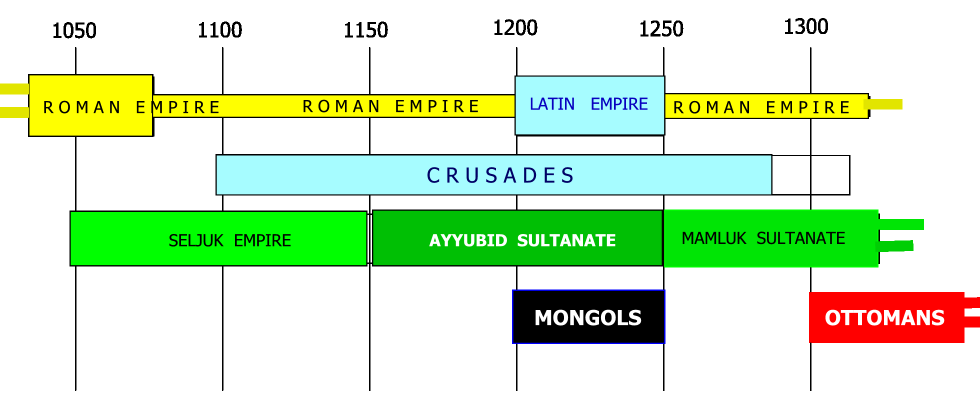 |
A Timeline of the period. Click on the image for a larger version. |
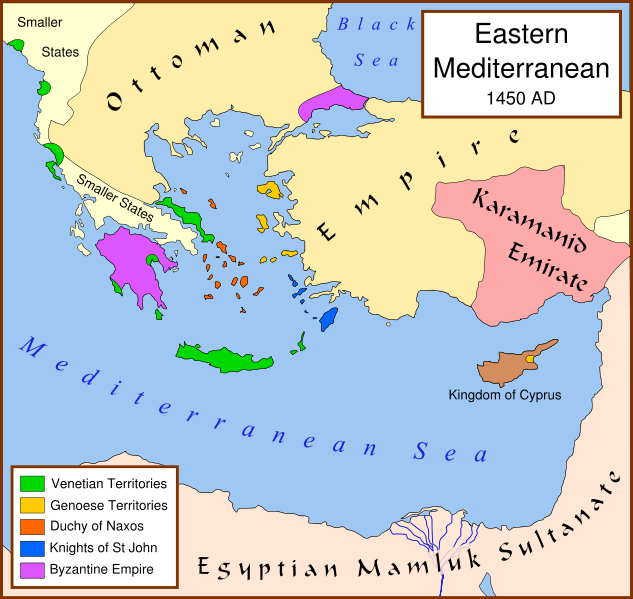 |
The aftermath of the Crusades, just before everything was taken by the Ottoman Turks. The only Latin possessions are in Cyprus, the Greek islands, and parts of the Greek mainland. Click on the map for a larger version. |
| Adapted from Wikipedia http://en.wikipedia.org/wiki/File:Eastern_Mediterranean_1450_.svg | |

Notes
- Article "Crusades" Encyclopedia Britannica, vol. 5 (pp. 297-310), Fifteenth Edition, 1982. Also articles on "Hospitallers" and "Templars".
- Article "Ismailiyah" Encyclopedia Britannica, vol. V (pp. 453-454), Fifteenth Edition, 1982.
- Bernard Lewis, The Assassins, Littlehampton, 2001.
First Posted: March 30, 2010. Latest Revision: December 3, 2011.