Topics in Middle East History
Chapter 11: Turks and Byzantine Decline
Copyright ©2010 by T. Pavlidis
The Mamluks
The last thousand years of Middle East history have been shaped by Turkish powers and now it is time to turn our attention to them. The first Turks in the Middle East arrived rather humbly, as slave soldiers, the Mamluks (or Mameluks). The Abbasid caliph al-Mutasim (833-842) is reported to have used them extensively [1, BL95, p. 87]. Gibbon describes them as "the hardy natives of Tartary, who at a tender age had been purchased by the Syrian merchants, and were educated in the camp and palace of the sultan." [EG, Chapter LIX, vol. 6, p. 130]. (The term Tartary refers to a large of Asia covering modern Turkestan, Siberia, and Mongolia, all the way to Manchuria.) The young slaves (at or near the age of puberty [2]) were converted to Islam and then were trained to be professional cavalry soldiers. They rose through the ranks to become officers so the leaders of the troops were also of slave origin. Sons of Mamluks were not eligible to serve in the troops, so the number of soldiers had to be kept up by new slaves. (This policy was changed under the Ottomans [1, p. 401].) At some points the slave recruits were switched from Turkish to Georgian and Circassians [1, 2]. Originally, there were also infantry troops consisting of black slaves and they gained considerable influence in Egypt by allying themselves with the black eunuchs of the palace but they were dismissed by Saladin (see below) in 1169 [2].
The Mamluk army consisted of three groups. The Royal Mamluks were the property of the sultan. The Mamluks of the Amirs were the property of officers who were members of the Royal Mamluks. Finally, there was a non slave cavalry unit consisting mainly of sons of Mamluks. [1, p. 400, 2nd col.]
The term slave soldier may appear self-contradictory to a modern reader and the term slave officer even more so but the term "slave" has to be understood in its historical context. Slavery meant that the individual had no other choice for his avocation than that assigned to him. It did not mean ill-treatment. Slave soldiers, and especially their leaders, were treated very well. The motivation for using an army of slaves is similar to that for using foreign mercenaries (see How to stay in power); their loyalty is only to the ruler and have no connection with the subjects of the ruler.
Of course, things did not always work that way. Given their shared experience, Mamluks developed loyalty to each other and to those leaders who came from their own ranks. Soon after the reign of al-Mutasim, Mamluk generals became de facto rulers of the caliphate. In 1250 they took power formally initiating two dynasties of Mamluk sultans who ruled over Egypt, Syria and the lands in between. The first dynasty (Bahri Mamluks) ruled during 1250-1382 and were mostly of Turkish origin. The second dynasty (Burji Mamluks) ruled during 1382-1517 and were mostly of Georgian origin [1]. Their sultanate was abolished when Egypt was taken over by Ottoman Turks (see Chapter 13), but Mamluks continued to hold positions of power well into the 19th century. When Napoleon invaded Egypt was quite impressed by them and he attached some Mamluk troops to the French army [2]. A major factor for the defeat of the Mamluks by the Ottomans was the reluctance of the Mamluks to use firearms [1, p. 400, 2nd col, BL95, 112-113]. Mamluks were well aware and proud of the superior skill needed to wield a sword, a bow, or lance. Any "dummy" could use a firearm and early firearms were less effective than arrows. But a state could raise a much bigger army of musketeers than of archers who had to be trained since youth.
Sources on Mamluks
1. Article on Mamluks in Encyclopedia
Britannica, Fifteenth edition, 1982, vol. 11, pp. 399-401.
2.
http://www.napoleon-series.org/military/organization/c_mameluks1.html.
"The Georgian Mameluks in Egypt" by Alexander Mikaberidze.
The Seljuk Turks (960-1250)
While Mamluk soldiers had converted individually to Islam a momentous event occurred in 960. A whole Turkish population, the Karakhanids, numbering to "200,000" tents converted to Islam as a nation and made the new religion the core of their ethnic identity [BL95, p. 88]. Eventually other Turkish groups migrated in that territory and also accepted Islam as their religion. The most notable amongst them was a group led by a chief named Seljuk who became known as the Seljuk Turks [ibid, p. 89]. By 985 they were found in the vicinity of Bukhara. Next they found allies within Persia who saw them as a way to counteract the influence of Shiite powers of the Fatimids and the Buyids (Chapter 7). (Persians were Sunni at the time. They did not switch to Shi'ism until 1501.) Very soon the Seljuks established an empire that stretched from what is now Uzbekistan through Iran all the way to Armenia and Syria. In 1055 their great leader Toghril Bey abolished the emirate of the Buyids and re-established the Caliphate of Baghdad over the area of modern Iraq. As a result the Seljuks were seen as delivering the Sunni Caliphate from the tyranny of the heretic Shias. The Seljuks also established the first network of religious schools (Madrasahs) with a unified administration in order to provide training according to Orthodox Islam. Thus the Seljuk empire had a religious as well as a political character. (See Article on Seljuks of Encyclopedia Britannica, Fifteenth edition, 1982, vol. 16, pp. 503-506. Gibbon's account [EG, Chapter LVII, vol. 6, pp.1-12] includes several details about the relationship between the Caliph and the Seljuk sultan.)
All this was happening while the Byzantines were torn by internal disputes and theological disputes with the Pope. In 1063 Toghril was succeeded by Alp Arslan who started attacking and taking over parts of the eastern provinces of the Roman Empire during the reign of Constantine X and soon after his death they sacked and burned Caesarea in Cappadocia. Soon after he took the throne in 1071 Romanus IV he mounted a campaign against the Seljuks. His army of over 100,000 men included not only Byzantine troops but also foreign mercenaries: Bulgarians, French, Normans, and Turks [ibid, pp. 13-15.] He defeated the Seljuk forces in Asia Minor and then moved to Armenia where he captured the key city of Manzikert. But then Romanus divided his forces sending the French and Normans towards another objective while Alp Arslan was approaching at the head a 40,000 strong cavalry. Alp Arslan offered a truce but Romanus rejected it. The Byzantines would have won the battle, if not for treachery. Part of their forces under Andronicus Ducas (son of the regent John Ducas) left the field of the battle; the French and Normans mercenaries refused to join the battle; and worst of all the Turk mercenaries went to the other side. Romanus IV was taken prisoner [EG, ibid, pp. 15-18] [WT97, pp. 602-604]. There is also a good Wikipedia article on the Battle of Manzikert.
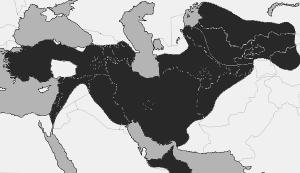
The battle was a major disaster for the Byzantines and 1071 represents the start of the end of their empire, especially because of the way they handled the defeat. Because of divisions within the Seljuks and because most of the Byzantine army had escaped, Alp Arslan agreed to favorable (for the Romans) treaty with Romanus and freed him. But Romanus had to face domestic enemies. The regent John Ducas proclaimed Michael VII sole emperor and had Romanus deposed. A series of battles between the forces loyal to Romanus and those to John Ducas followed. At the end Romanus was captured by his enemies and blinded. He died from infection in his blinded eyes in 1072. Understandably, the Seljuks were no longer bound by the treaty they had signed with Romanus and resumed their advances against the Romans. Alp Arslan had also been killed by a prisoner and he had been succeeded by his very capable son Malik Shah. While the Byzantines were fighting each other, the Turks captured most of Asia Minor. In the span of 50 years misgovernment had caused the empire to lose half of its territory. [EG, ibid, pp. 18-21] [WT97, pp. 604-607]. At the end of the 11th century the Seljuk had a large empire stretching from Iran to the border with Egypt (Figure 1). The caliph was a figurehead under the "protection" of the Sunni Seljuk Sultans [EG, Chapter LVII, vol. 6, pp.1-12][BL95, pp. 89-90]. Lewis notes that "In their administration, the Seljuks relied largely on Persians and on the well-entrenched Persian bureaucracy" [ibid, p. 92]. Of course, the Seljuks continued to use Mamluk soldiers.
Pretty soon the Seljuk empire split into several sultanates, one of them, centered in Asia Minor, was the Sultanate of Rum. The connection to Rome was preserved even under Seljuk rulers! Around 1150 there was a consolidation of power under Emir Nur al-Din. Nur al-Din and his Kurdish general Salah al-DIn (or Saladin) are best known for their fights against the Crusaders that we discuss below. In 1172 Saladin took over Egypt, abolishing the Fatimid caliphate and after Nur al-Din's death in 1174 he took also control of Syria, establishing the Ayyubid dynasty (1171-1246). See Figure 2 for a map. However, the unified Syro-Egyptian sultanate did not survive Saladin's death in 1193 [BL95, pp. 90-91]. Finally, in 1250, the Ayyubids were replaced by the Mamluk sultanate.
 |
 |
| Figure 1: Extent of the Seljuk Empire near the end of the 11th century. Click on the link below for a full size color version. | Figure 2: Extent of the Ayyubid sulatnate (in red) at the end of the 12th century. Crusader states are shown in green. |
| Adapted from http://en.wikipedia.org/wiki/File:Seljuk_Empire_locator_map.svg | Adapted from http://en.wikipedia.org/wiki/File:Ayyubid_Dynasty_1171_-_1246(AD).PNG |

.PNG)
The Aftermath of the Loss to the Seljuks
The Byzantine throne passed to Alexios I Comnenos in 1081 who was the nephew of emperor Isaac and he had also distinguished himself in putting down rebellions by foreign mercenaries. Alexios asked the Pope of Rome for help against the Seljuks but he got more than what he bargained for. In 1096 the disorganized masses of the "people's crusade" led by Peter the Hermit arrived in Constantinople. Alexios gave them passage to Asia MInor where they were promptly massacred by the Turks. The following year saw the arrival of the knights of the First Crusade. With their help Alexios was able to recapture the coastal regions of Asia Minor. The Crusaders went on to capture the lands around Syria and Israel capturing Jerusalem in 1099 and massacring its Muslim and Jewish inhabitants. They established the kingdom of Jerusalem, the principality: of Antioch, and the counties of Edessa and Tripoli. Overall the first Crusade proved helpful to the Byzantines and by the middle of the twelfth century the empire occupied the area shown in Figure 3. Alexios was succeeded by his son John II (1118-1143). Treadgold [WT97, pp. 612-637] provides an extensive account of their rule and their dealings with the Crusaders while Gibbon [EG, Chapter XLVIII, vol. 5, pp. 122-127] provides interesting observations on their characters as well as accounts of the palace intrigues. Gibbon provides a more favorable judgments on these two emperors than Treadgold. Gibbon rates John as the "best and the greatest of the Comnenian princes" [ibid].
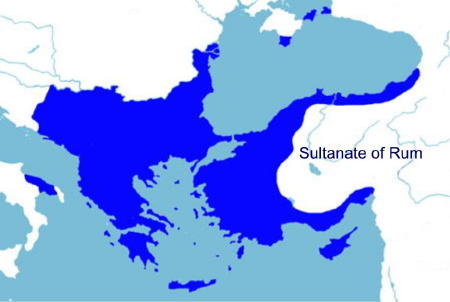 |
Figure 3: Lands of the Byzantine
Empire in 1156 (in blue). Compared to Figure 1 of Chapter 10 the
major losses are in Asia Minor and in Italy. These will never again
be under Greek rule. |
| Adapted from http://hobbit.ict.griffith.edu.au/wiseman/Roman/Decline&Fall.html | |
John II was succeeded by his son Manuel I (1143-1180) who proved a capable emperor. One of his first acts was to subjugate the crusader principality of Antioch and make it a vassal state of Byzantium. However, this was against the long term interests of the empire because it strengthened the Turks. He married Bertha, a relative of the German emperor Conrad in order to secure an alliance against the Normans in Sicily and the French in Antioch. The Second Crusade took place during 1147-49 and it started with atrocities against the Jews in Rhineland. As the Crusaders passed through the Balkan part of the Roman empire they did considerable looting. Eventually, they were unable to inflict any significant damage to the Turks, so that crusade was a failure [WT97, pp. 638-641]. Manuel was arguably the last strong emperor of the Byzantines and the last time that the state was a still a power to be reckoned with by both the Western Europeans and the Turks. [EG, ibid, pp. 127-130].
Dealing with the Crusaders
After Manuel's time the empire was torn by civil strife. Manuel was succeeded by his 11 year old son Alexius II who three years later was killed by Andronicus I Comnenus, a cousin of Manuel I. He was also killed three years later and that ended the dynasty of the Comneni. Isaac II became emperor in 1185 and had a tumultuous reign. He was toppled and blinded by his older brother Alexios III Angelos who reigned during 1195-1203. He was overthrown by the the army of the Fourth Crusade who put Isaac back to the throne for one year, until in 1204, the crusaders sacked Constantinople and established the Latin Empire in place of the Roman Empire. However the change was in name only and the possessions of the crusaders were fragmented. The main Latin empire covered parts of Greece and a small part of Asia Minor while several of the islands, including Crete, came under the rule of Venice. Three Byzantine states were formed from lands that were kept out of the reach of the Crusaders. The Empire of Trabizond was in eastern Asia Minor, along the coast of the Black Sea and was ruled by members of the house of Comneni. The Empire of Nicea was in northwest Asia Minor ruled at first by Theodore I Lascaris, son-in-law of Alexios III [WT97, pp. 712-715]. The third state was the despotate of Epirus in the mountain region in northwestern Greece and in parts of what is now Albania.
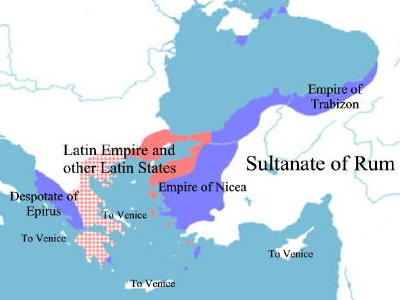 |
Figure 4: The
Latin Empire (In red), Latin Principalities (red dots), and Byzantine
possessions in blue. |
| Adapted from http://hobbit.ict.griffith.edu.au/wiseman/Roman/Decline&Fall.html | |
These three states fought each other and the Latins. The Empire of Nicea became eventually the most prominent state under the rule of John III, surnamed Vatatzes (or Vataces). He reigned for thirty three years (1221-1254) and he used French mercenaries in his wars against the Latins [EG, Chapter LXI, vol. 6, p. 195 and pp. 201-2]. He was succeeded by his son Theodore II Laskaris, a mean tyrant according to Gibbon. One of his atrocities was committed against a woman who incurred his displeasure: "her body, as high as the neck, was enclosed in a sack with several cats, who were pricked with pins to irritate their fury against their unfortunate fellow captive" [ibid, pp. 219-220]. Such a punishment of women was used by the Ottoman sultans and has often been cited as sign of their barbarism. However, the sultans simply followed a practice of the Christian Byzantine rulers.
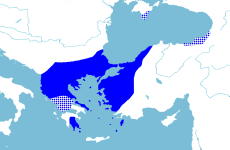 |
Figure 5: The
Roman Empire circa 1288. Most of the Latin possessions are gone
and some of the break-away Byzantine states recognize the emperor
in Constantinople. In the Greek mainland the Principality of Achea
and the Duchy of Athens are still in Latin hands as well as island
of Crete. |
| Adapted from http://www.cit.griffith.edu.au/wiseman/Roman/19Maps.html#1288 | |
Theodore died in 1258 and he was succeeded by his seven year old son John Lascaris. The general Michael Paleologus became regent and then he declared himself co-emperor. In 1261 his general Alexius Strategopoulos captured with little resistance Constantinople from the Latins putting an end to their empire [WT97, pp. 719-733, EG, Chapter LXI, vol. 6, pp. 203-205]. However some Latin principalities remained. The map of Figure 5 shows the Byzantine possessions at their maximum in 1288. The success of the Byzantines is due to no small extend to the fact that the Seljuk Turks had to fight the Mongol invasion led by Genghis and his successors (Chapter 12). However a comparison of the maps of Figures 3 and 5 shows that the net result of Crusades was a weakening of the Roman empire that left it less able to deal with the Turkish threat from the East.
Self Inflicted Injuries
The Roman Empire might still have survived if it were not for misgovernment and internal strife. Michael Paleologus blinded the legitimate emperor John Lascaris in 1261 and appointed his own son Andronicus II Paleologus as co-emperor, thus establishing the Paleologus dynasty, the last one of the Byzantine Empire. Gibbon lists several misdeeds of Michael Paleologus [EG, Chapter LXII, vol. 6, pp. 226-235]. He gave exclusive possession of the suburb of Galata to the Geneose "in which they ... insulted the majesty of the Byzantine empire" [ibid, p. 226]. He forced a union of the Eastern church with the Catholic accepting the supremacy of the Pope and the Catholic dogma but that union did not survive his death in 1282 [ibid, p. 234].
Andronicus II reigned for over 40 years, until 1328. Gibbon characterizes him as being overly concerned with religious affairs [EG, Chapter LXIII, vol. 6, pp. 247-48] and he made several bad decisions. Around 1300 he hired the so-called Catalan mercenaries to fight the Turks. They were about 8,000 of them under the leadership of Roger de Flor and they did inflict damage onto the Turks. However, pretty soon they turned against the Byzantines and eventually took over parts of Greece [EG, Chapter LXII, vol. 6, pp. 241-245]. Andronicus had appointed his son Michael IX as co-emperor but he died before Andronicus. Michael's son Andronicus (named after his grandfather) had caused the death of his own brother and Andronicus the elder meant to try him in court for the crime. However, the younger Andronicus escaped and started a civil war that raged for seven years until 1328 when the elder Andronicus was deposed [EG, Chapter LXIII, vol. 6, pp. 250-255]. In the meantime the Ottoman Turks appeared on the scene and captured the Byzantine province of Bythinia, across the sea of Marmara from Constantinople (See Chapter 8). Gibbon has given the title "Civil Wars, and Ruin of the Greek Empire" to the chapter where these events are described [EG, Chapter LXIII]. The chapter ends 100 years before the final fall of Constantinople suggesting that many of wounds of the Byzantine Empire were self-inflicted. The last part of Treadgold's book is titled "The Failed Restoration" [WT97, pp. 735-844] and provides the sad story of those years in a more concise form than Gibbon.
By the middle of the 14th century the one mighty Roman Empire consisted of the immediate area around the capital and territorial fragments (including islands) in Greece and Western Asia Minor. The commentator to Gibbon provides a list of these places according to the historian Finlay [EG, Chapter LXIII, vol. 6, p. 261]. We will describe the final end of the Byzantine empire in the context of the rising Ottoman power in Chapter 13 but before we leave the subject there are two stories worth narrating.
The Geneose territory at Galata proved quite troublesome to the Byzantines and they turned for help to the Venetians. A naval battle between the two Italian maritime powers was fought near Constantinople and ended in favor of the Geneose. Gibbon notes the irony of the Roman Empire becoming a province of Genoa, a prospect that was averted by the ultimate triumph of Venice. [EG, Chapter LXIII, vol. 6, pp. 271-272].
The other, also from Gibbon, deals with some bizzare religious belief of the times, that introspection would allow one to see God in the form of light similar to the Metamorphosis on Mount Thabor related by the Gospels. The emperor John Kantakouzenos was pre-occupied with the question "... he defended with equal zeal the divine light of Mount Thabor, a memorable question which consummates the religious folies of the Greeks" [ibid, p. 265]. Kantakouzenos "presided in the synod of the Greek church, which established, as an article of faith, the uncreated light of Mount Thabor" [ibid, p. 266]. This theological debate was raging while the Ottoman Turks were building up their empire across the sea of Marmara.
First Posted: March 8, 2010. Latest Revision: December 5, 2010.